Building the practice tool I wish I had when I was a music student
Executive Summary
PercussionIQ is a business a few friends of mine and I operate as a small passion project on the side. Each of us has our own has our own career, life, and some of us even have kids. But this business serves as an outlet for us to stay connected with the activity through which we all came to know each other, music. As decorated performers and educators in this space, we have spent the past 8 years building a business that solves a problem that we all dealt with: as a percussionist and student, there was not enough guidance and resources available to help us reach the highest level without “meeting the right people.”
We’ve taken the big step to begin delivering our methodology, resources, and a set of practical tools via our new product: The PercussionIQ App, releasing Summer 2025
Roles I played:
Design, User Testing, Product Management, Product Marketing
Timeframe:
2025
Business Model:
B2C
User:
Percussionists (Students & Educators)
The app is designed to help percussionists expand their skillset, whether it’s their rudimental vocabulary or their knowledge of music theory.
Our North Star vision for the product is to provide a robust set of tools and features that empower users to integrate the app into every aspect of their journey towards musical performance goals.
At launch, the app will operate on a freemium model, with certain features included in a one-time purchase. Eventually, once we build out the entire set of tools and features, we will move towards a tiered subscription model.
What problem does this solve?
Our app is built off the same core problem/solution dynamic that rests at the core of the business. A budding percussionist looking to reach the highest level, is often limited by the tools and resources available surrounding them.
While there are a host of tools available on the market for musicians, like Synkd and BeatNote, they don’t tailor specifically to our community and their pricing models have been met with negative feedback from users.
How can we empower our user, the percussion student, no matter where they are in the journey, to get better, faster? To turn dreams into goals, and goals into reality?
Understanding the User
I’m going to be honest, there wasn’t a whole lot of research conducted here BEFORE building. We leaned on our own experiences going through our user’s journey, experiencing the pain points firsthand. We’re talking a collective 40+ years of lived experience. Here’s a breakdown of what we understand our persona to be:
Aspiring Percussionists
Who:
High School Students, Professional Performers, or even Educators
User Goals:
To rapidly increase musical ability. To audition for and secure a spot in an ensemble, whether it be high school drumline or a competitive drum corps. Or to improve outcomes for students of their own.
Pain Points:
Not knowing how to start, how to get past plateaus. What do I practice? How do I practice it? What are the best in the activity doing, and how did they get to where they are now?
Business goals
As a small team, with not a lot of time, and not a lot of technical ability, we need the product to:
Provide a toolset that can’t be found in any other app
Integrate PercussionIQ methodology & content
Provide as much as possible, for free
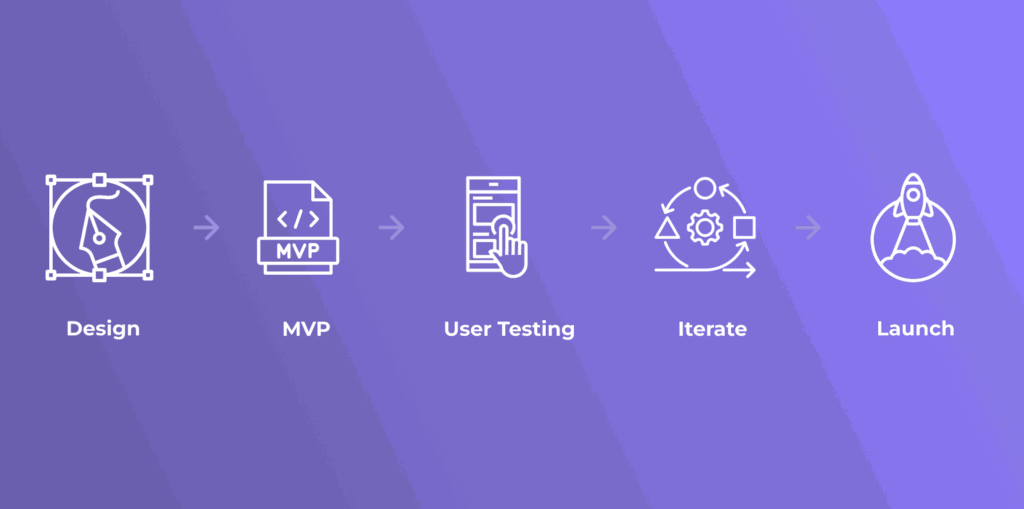
Process
After establishing our goals, constraints, and design principles, the project went through the following milestones:
Minimum viable product:
For the MVP, we sketched a basic idea of the UI. Then, we built a live prototype using SwiftUI, leaning on AI tools to help us rapidly construct the core logic and troubleshoot. This live prototype was one tool, GridLab, which you can learn about below.
User testing
We conducted remote usability tests with 5-10 members of our personal network using the MVP build distributed via TestFlight. These users, like us, were also musicians. The results informed significant design changes we would make.
Iterations and Further Testing
We expanded our testing network to younger performers and educators and began collecting feedback inside TestFlight as well as via one-on-on conversations. We implemented changes to the UI in alignment with the feedback we were getting and rapidly made additions to the feature set of the tool as our participants pointed out the “gaps” in functionality we hadn’t yet considered. We also began adding tools from our product roadmap to add value to the app ahead of launch.
Based on our testing and user feedback, here are some of changes we made and features we added:
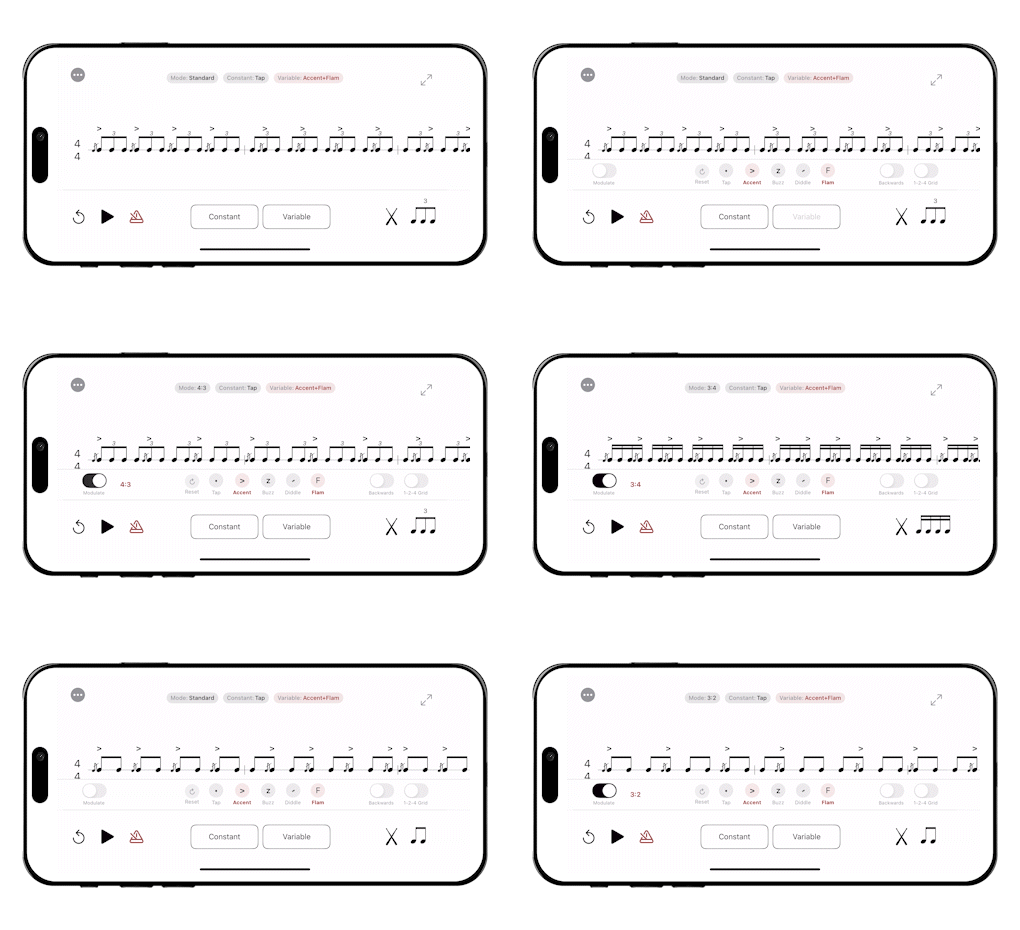
Core Tool - GridLab
Grids, like scales for the pianists and vocalists, are a universal warmup exercise for percussionists. They are used to expand musical vocabulary. Try different rudiments, or stickings, or stroke types and play them in every possible variation.
GridLab, puts that power in the user’s hands. An open sandbox for the creation of just about any grid that can be thought of.
Feature Addition - Modulate
Some of the more advanced percussionists that participated in the user tests highlighted a key feature gap related to a musical concept called metric modulation. If you’re a musician you know what this is, if you’re not, just understand that layering a modulation over a grid presented a unique core logic challenge that our team was ultimately able to handle!
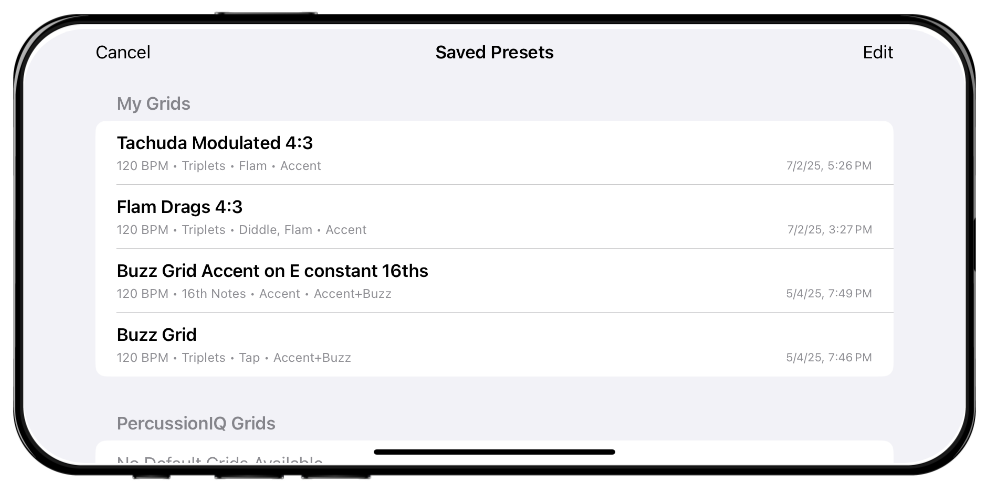
Feature Addition - Save and Load Grid
“I want to be able to reload the grid I created last time without having to create it from scratch”
Including a save & load feature was a no-brainer as it removes a ton of friction for repeat users and creates an opportunity to add to the value of the premium version of the app through Grid Presets.
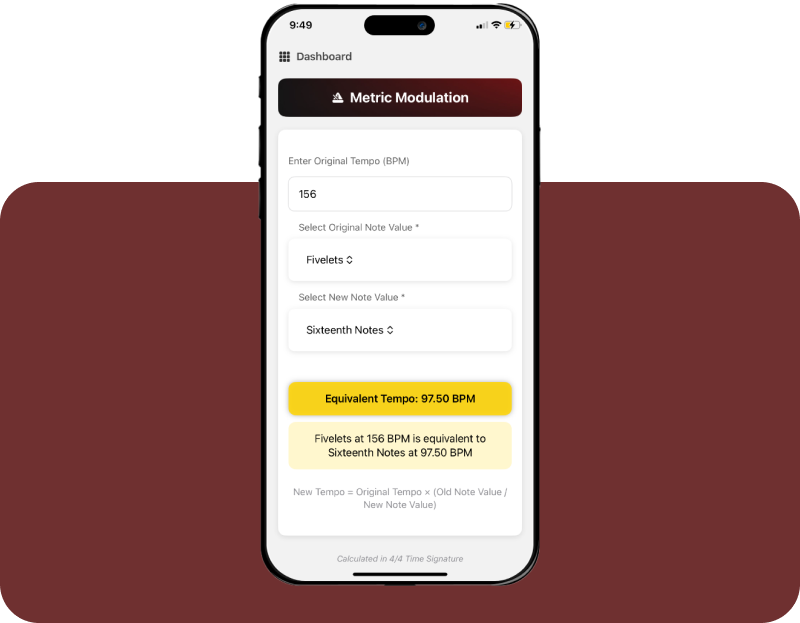
Core Tool - Modulation Calculator
After building our MVP, we added a new tool to the app to begin moving it in the direction of our North Star. This calculator is a tool that previously lived on our website and is used to help our user analyze their music from a different perspective.
Core Feature - Methodology Content
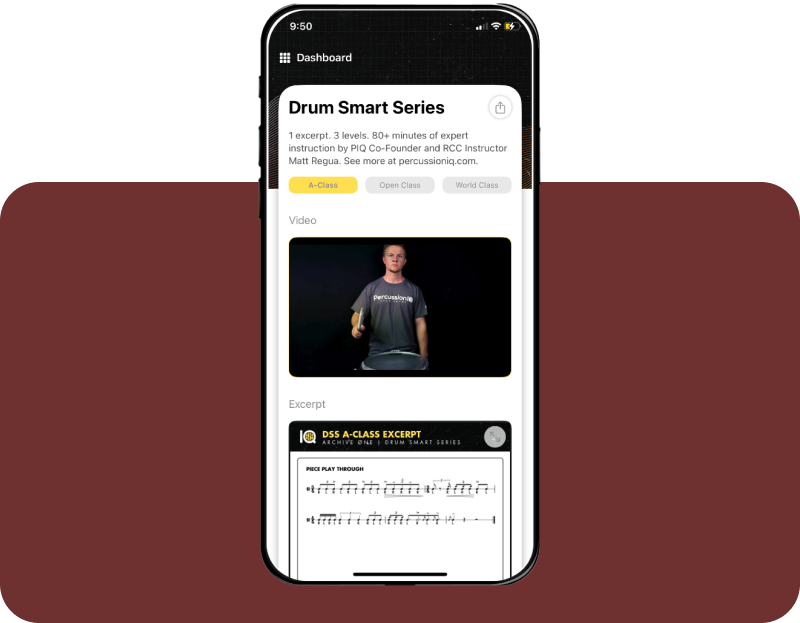
A key aspect of the Percussion IQ business model is an inbound marketing strategy focused on growing our community and providing them with consistent, valuable content that guides them towards their musical goals.
We now plan to use this product as a means of delivering that content, and ultimately give ourselves a completely cost-free means of reaching our audience.
Information Architecture - New Dashboard
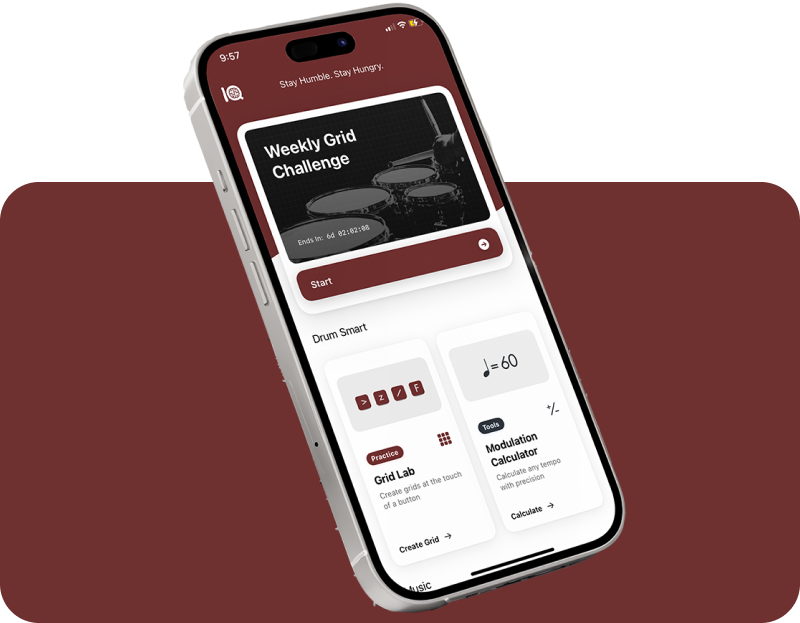
Since the MVP build was one singular tool and we had now added a host of features and tools, there was a need for a “homebase.” This dashboard brings all tools and resources together in one screen and will ultimately grow to include the various tools we plan to add in the future.
Launching Summer 2025
Reflections
User Testing Organization:
As a bootstrapped team, with only a couple of us having UX expertise, we collected feedback with text messages and phone calls. It allowed us to get great qualitative feedback, but the implementation of a a proper feedback survey could have yielded more insights. We are already working on a system to gather feedback in this way, post-launch.